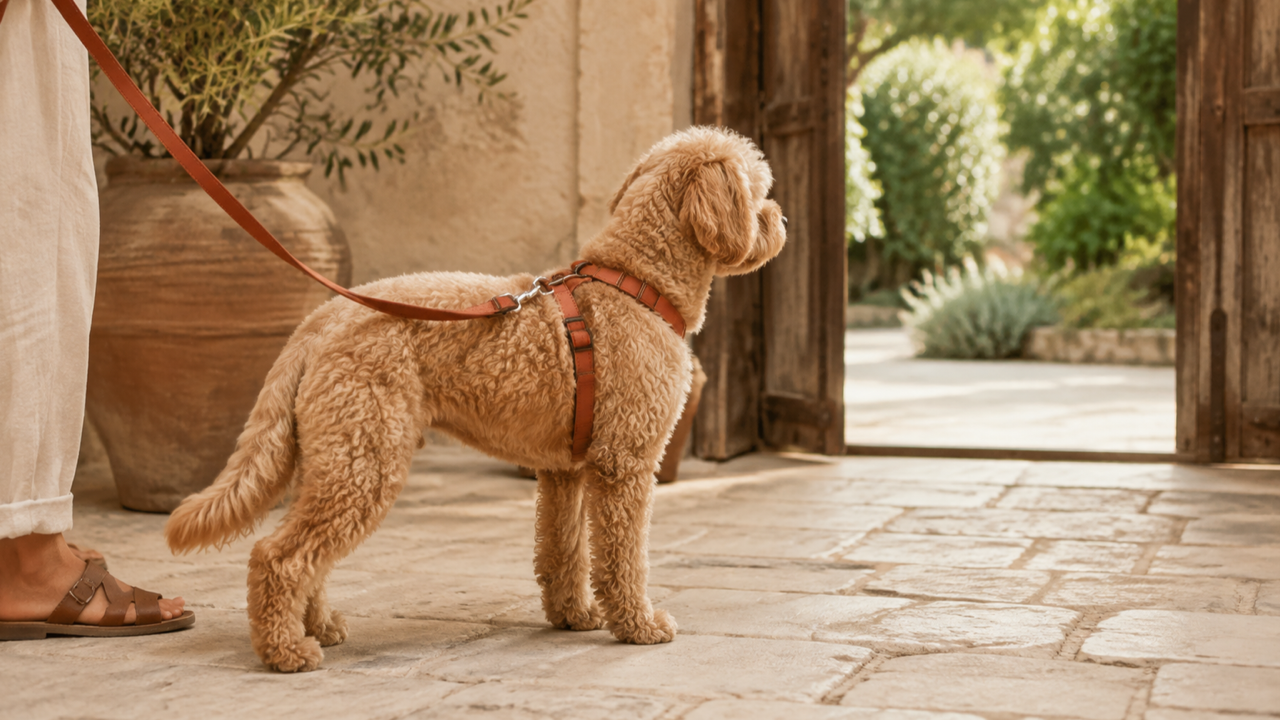
A dog harness should sit securely without squeezing, rubbing or getting in the way of ordinary movement. Your dog should be able to walk, sit and lower their head comfortably, while the harness stays in its intended position. Start with the instructions for that exact model, then check the fit on your moving dog.
That last part matters. A harness can look convincing beside the front door and tell a different story halfway down the street. The size label is a starting point. The dog wearing it gets the final say.
Start with measurements, not the breed on the box
Before ordering, find the maker’s measuring diagram. Use a soft tape and measure with your dog standing naturally. Chest girth usually means the circumference around the widest part of the rib cage, behind the front legs. Some models also need a neck measurement; take it where the diagram shows, rather than assuming your collar measurement will do.
The American Kennel Club’s measuring guide explains these measuring points and notes that sizing differs between brands. A medium in one range is not a promise about another.
Write down the measurements, the date and the exact model you are considering. It is a small administrative task that saves you trying to remember whether the number in your phone was a chest measurement or a delivery code.
If your dog sits between sizes, check the manufacturer’s advice before ordering. Ask which size accommodates all the measurements, and whether the straps can adjust enough. Buying extra room without checking the finished fit leaves the actual question unanswered.
Adjust the harness in a quiet room
Choose a moment when you are not already late for the walk. Keep the door closed and give yourself room to see both sides of your dog.
Open the fitting instructions, identify the front and back, and follow the maker’s sequence. Different constructions adjust differently. For example, Ruffwear’s Front Range instructions advise extending the straps before tightening them to fit. That is guidance for that design, not a universal assembly method.
Work through one adjustment at a time. Check that straps lie flat, buckles are fully closed and no fur is caught. Look at the harness from the front, side and above. A mirror or a second person can make this easier than repeatedly asking your dog to turn around.
Keep the packaging until you have completed the indoor check. If the shape is wrong, being able to exchange it is more useful than having committed to the colour.
Use the finger check as one part of the assessment
You will often see a two-finger rule: space to slide two fingers between the harness and your dog. The AKC’s harness guide describes this as a useful rule of thumb. Follow the clearance specified by your harness maker, and check more than one strap.
Do not treat a single gap as proof that the whole harness fits. Your fingers cannot tell you everything about its position or what happens when your dog moves. A comfortable gap at the chest does not explain why a different strap keeps shifting.
The useful question is broader: does this model sit where its fitting guide says it should, with comfortable clearance and without moving out of position? If you cannot satisfy both comfort and security, ask the maker or an experienced fitter to check it.
Watch what happens when your dog moves
Once the stationary fit looks right, invite a short walk around the room. Let your dog sit, turn and lower their nose naturally. Avoid pulling them into poses to test the equipment.
Watch the shoulders and the straps near the front legs. Dogs Trust’s harness guidance recommends choosing a design that does not restrict movement and checking that the dog cannot slip out. It also stresses that a harness does not replace teaching comfortable walking on a lead.
Notice whether the harness stays centred or repeatedly rotates. Does your dog move as they usually do? Does a strap shift into the space behind a front leg? Take a short side-on video if the movement is difficult to judge while you are also holding the lead.
If something looks wrong, pause and revisit the fitting guide. Do not tighten every strap simply to stop movement somewhere else. If adjusting one area makes another uncomfortable, this may be a shape problem rather than an adjustment you have missed.
Make the first outing a fitting check
Once the indoor checks pass, choose a short, familiar outing before committing to a long walk. Give yourself an easy way home if you need to stop and change equipment.
On your return, remove the harness and check the areas beneath it for rubbing or irritation. Note any repeated slipping, strap adjustment or change in your dog’s movement. A photograph of the fitted harness can help when asking the manufacturer for advice; include a side view and explain what happened during the walk.
If your dog seems painful or you find damaged skin, stop using that harness and contact your vet. If your dog has a history of backing out of equipment, get individual fitting advice before relying on a new setup outdoors. An escape claim on a product page cannot assess your particular dog.
Choose for the routine you actually have
Fit comes first. After that, consider the small details you will handle every day. Can you reach the adjustment points easily? Can you operate the buckles comfortably? Are the cleaning instructions realistic for the places you walk?
Check the retailer’s fitting and return policy before buying. An indoor trial may be treated differently from an outdoor walk. If you are shopping in person, ask whether your dog can try the harness and whether someone can help assess it.
For a dog uncomfortable with equipment going over their head, a design that clips around the neck and body may be worth considering. Introduce any new harness gradually and reward relaxed investigation rather than rushing the first fitting, as Dogs Trust advises.
Our guide to choosing dog travel gear that actually gets used considers the same everyday question: how easily does an item fit into your routine? For a harness, start that assessment with your dog’s comfort, then your own ease of use.
Revisit the fit as your dog grows or their body shape changes, and inspect the equipment for wear. The goal is a harness you can put on with confidence, then get on with the walk. Your dog has a very full schedule of things to sniff.
Join the Ottimo Plus waitlist for updates on thoughtful gear for everyday life with dogs.