Many people sleep better with a dog nearby. Many others sleep worse. Both are true, which is why the question of whether a dog belongs on the bed rarely has a single answer.
The useful way to look at it is simple. Does the arrangement give you and your dog good sleep, and can you keep it clean and consistent? If so, it works. If not, it is worth changing. This guide sets out when sharing a bed makes sense, how to do it well, and how to move a dog off the bed without a fuss.
Set aside the dominance myth
You may have heard that a dog on the bed is a dog who thinks they are in charge. That idea is outdated. Dogs do not sleep where you sleep to climb a social ladder. They sleep there because it is warm, comfortable and close to the people they like.
So the question is not about spoiling or status. It is about sleep, hygiene and the particular dog and household involved. A dog who sleeps on the bed is not misbehaving, and a dog who sleeps on the floor is not neglected.
What sharing a bed offers
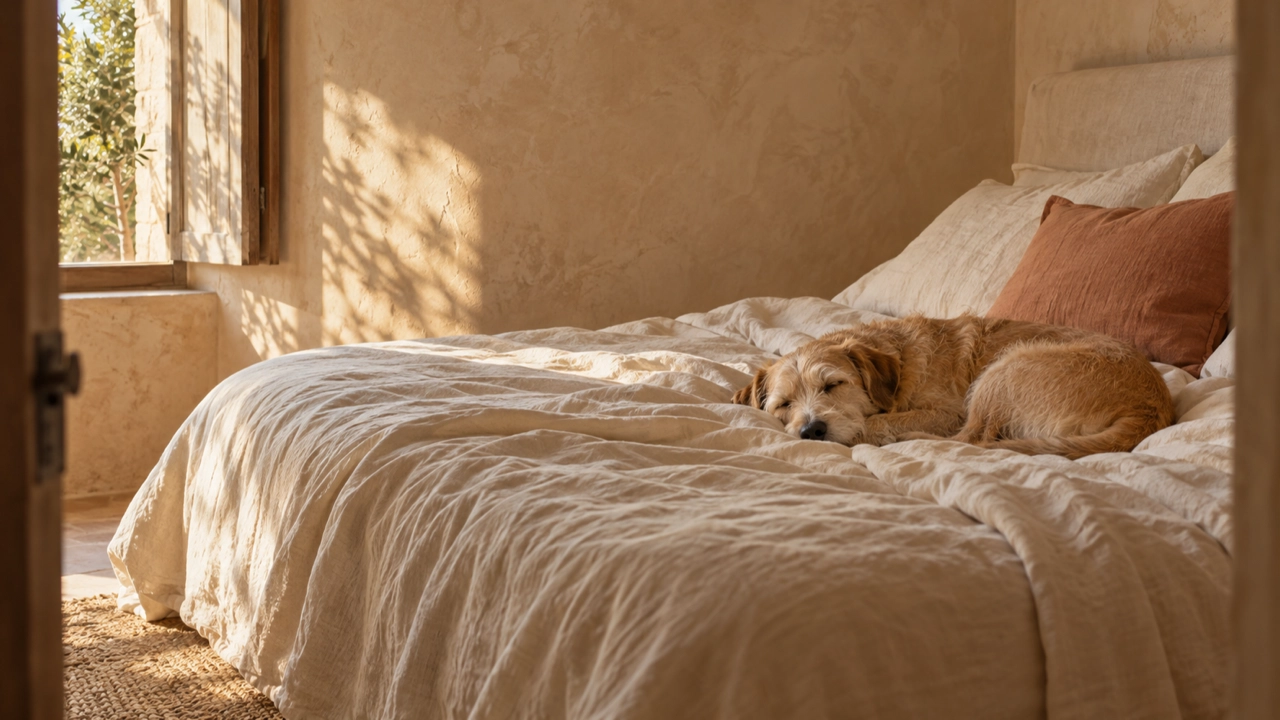
For a dog who enjoys contact, a shared bed is simply a good place to be. It offers warmth, closeness and the reassurance of a familiar person nearby. Many owners value the same things. A dog settled against your legs can make a quiet room feel calmer.
There can be practical benefits too. A dog who sleeps within reach may let you know when they need to go out, which some owners, particularly those with puppies or older dogs, find convenient. Others find it makes no difference at all.
These are benefits for the right pair. A dog who prefers space, or a person who wakes at every movement, may find none of them.
When it tends to go wrong
Bed sharing fails for ordinary reasons more often than dramatic ones. Look at your own nights honestly.
- Mismatched sleep. Dogs rest in short bursts and often stir, shift and rearrange themselves. If you wake each time, your sleep will suffer. Our guide to how much sleep a dog really needs explains why they move around more than we do.
- Size and sprawl. A large dog in a small bed can leave one person on the edge of the mattress. Comfort has to work for everyone in it.
- Allergies or asthma. If anyone in the household reacts to dogs, the bedroom is the place where it matters most.
- Parasites and hygiene. Ticks, fleas and outdoor dirt travel easily from coat to bedding.
- Young children. Babies and small children need close supervision around any dog, and a shared bed is not the place to provide it.
- Guarding or startle reactions. A dog who growls over the bed, or who snaps when woken suddenly, should not share a sleeping space until you have taken advice from a qualified behaviourist or your vet.
- Pain or mobility problems. A dog who is stiff or sore should not be jumping on and off a high mattress. It is easy to miss this one.
How to make it work
If none of those apply and you both enjoy the arrangement, a few simple habits make it comfortable and clean.
- Make room. The bed should be big enough for everyone to stretch out without negotiating.
- Give your dog a defined spot. A particular side or the foot of the bed, perhaps with a small blanket, helps them settle without taking over.
- Wash bedding regularly. A dog’s presence means more hair, dust and dirt, so wash sheets and any dog blanket more often than you would otherwise.
- Wipe paws and coat after walks. Cleaning up before bed keeps mud and pollen off the sheets. Our guide to cleaning dog paws after a walk shows a quick routine.
- Keep parasite prevention up to date. Follow your vet’s schedule, and check your dog’s coat after time in long grass or woodland.
- Take a last toilet trip. A final visit outside before bed helps everyone sleep through.
Treat this as a routine, not a set of rules to remember. Once it becomes habit, the effort is small.
Consistency matters more than the rule
Dogs cope well with clear arrangements and badly with mixed ones. A dog allowed on the bed on Sunday, scolded on Monday and invited again on Tuesday cannot tell what is expected. That uncertainty is likely to unsettle them more than whichever answer you choose.
There are three honest options. Your dog can sleep on the bed all the time, only when invited, or never. Pick the one that suits your household and keep to it. If you use an invitation, make it a clear signal, such as a particular word or a pat on the mattress, so your dog waits to be asked.
There is also a middle option that many people like. Keep nights separate and make the bed a place for morning cuddles. Your dog gets the closeness, you get an undisturbed night, and the arrangement stays predictable.
How to move a dog off the bed kindly
If the bed is no longer working, you can change it. Dogs adapt, but they do better when the change is gradual and the alternative is attractive.
First, make the new place excellent. Put a comfortable, supportive bed right beside yours, where your dog can still see and smell you. Its position matters as much as the bed itself. A bed in another room is a bigger ask.
Next, reward your dog for settling there. Praise and a small treat when they lie down teach them that this is a good place to be. Do not drag them off the mattress or scold them. Calmly guide them to their own bed and reward the move.
Then expect a few nights of protest. Whining and wandering are common at first and usually fade as the new routine takes hold. Stay consistent and avoid giving in at 3 a.m., because that teaches your dog that persistence pays. If the protest is intense or goes on for weeks, speak to your vet to rule out pain or anxiety.
You can also move in stages. Start with the dog on the bed only at certain times, then shift to the bedside bed over a week or two.
When it is simply the wrong arrangement
Sometimes the answer is plain. Allergies, a weakened immune system, a new baby or young children, pain or mobility problems, and guarding behaviour all point towards a separate sleeping space. If any apply, or you are unsure, ask your doctor or vet, and do not feel you are letting your dog down by choosing a separate bed.
A good bed on the floor beside yours is not a lesser outcome. Your dog still sleeps close to you and still feels part of the household, and some dogs simply settle better with a space of their own. For a dog with sore joints, a supportive bed at floor level can be kinder than a high mattress.
Where that bed goes, and what it looks like, is part of a considered home. A quiet corner of the bedroom, a washable cover and a bed that holds its shape make a sleeping area that suits the room as well as the dog. Our guide to designing a home that works with a dog covers the wider picture.
The right answer is the one that lets both of you sleep well. For some pairs, that is a shared bed. For others, it is a separate bed an arm’s length away. Choose what suits your household, be clear about it, and your dog will settle into whatever you decide.