A dog park has a sign on the gate with a handful of rules. Close the gate behind you. Pick up after your dog. Keep dogs under control. The rules that decide whether the visit goes well are not on the sign.
Those rules are social, and regulars follow them without discussing them. They are easy to learn once you know what to look at. This is general guidance for owners, not behavioural or veterinary advice. If your dog shows persistent fear or aggression, a qualified behaviourist is the right person to ask.
Read the park before you open the gate
Stop at the fence for a minute. Count the dogs. Look at how they are moving: loose and bouncy, or stiff and fast. Notice whether there is a crowd at the gate, because dogs gather there to inspect whoever comes in, and a dog arriving into a pack of strangers has no room to retreat. Look at the owners too. People who are relaxed and watching their dogs make for a calmer park than people absorbed in phones or conversation.
If the mood feels wrong, walk on. You have lost nothing.
The entry moment
The gate is the most tense point of the visit. Most parks have a double gate for a reason: use it. Close the outer gate before you open the inner one, and take the lead off inside the second space, not in the doorway.
If dogs are crowding the inner gate, wait until they drift away. Walk in with a loose lead, then unclip once you are through and your dog is calm. A dog who bursts in at speed starts the visit at the top of its arousal, and the other dogs notice.
Greeting, and the cluster
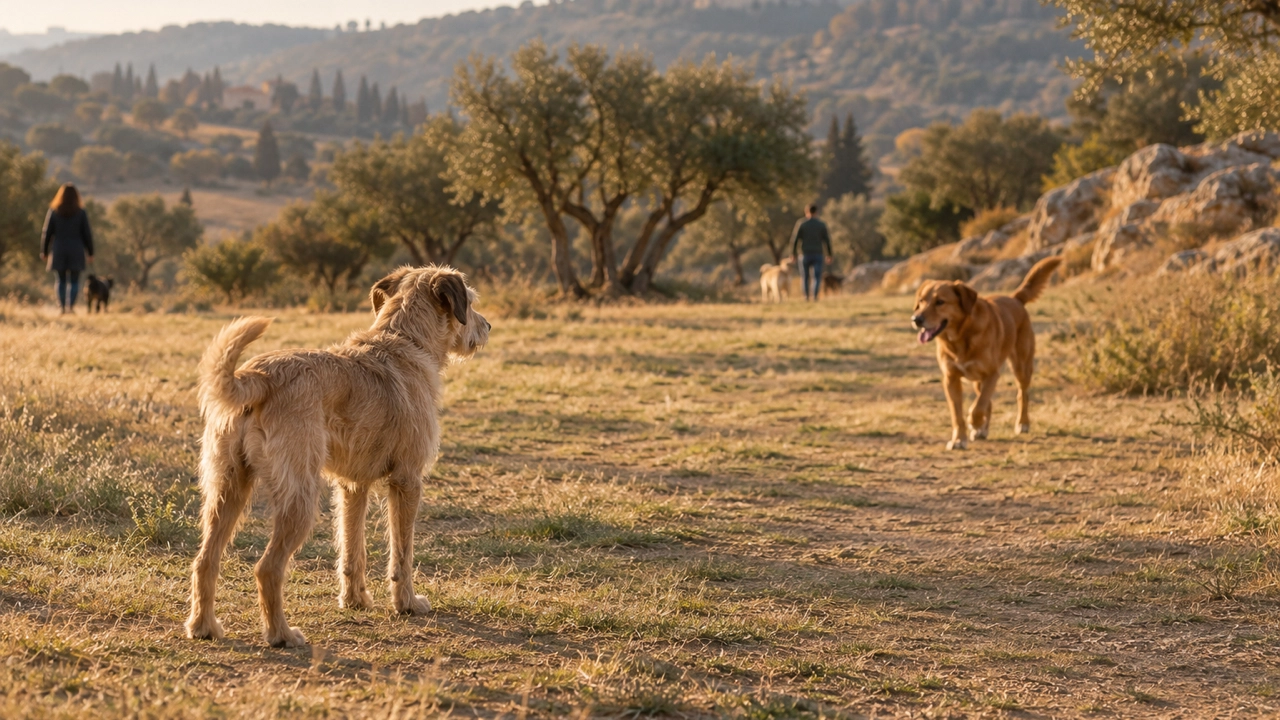
New arrivals get inspected. A short sniff, a circle, a pause: that is normal, and it usually sorts itself out in seconds. What you want to avoid is the cluster, where three or four dogs press around one newcomer. Even friendly dogs can overwhelm one another that way.
Keep walking. Moving on, with your dog following, is often enough to break it up. Standing still and hovering makes it worse. If your dog is the one drawing the crowd, call them away and let things settle.
Playing, or being mobbed?
This is the skill that matters most, and it is a matter of observation, not rules.
Play tends to look loose. Dogs swap roles: one chases, then the other. They pause, take breaks and start again. Their bodies are soft, and the noise, while it can be loud, comes and goes.
A dog who is being mobbed looks different. They are always the one being chased, or pinned, or crowded. They try to leave and cannot. They freeze, tuck their tail, hide behind you or cling to the fence. Stiffness is the clearest sign. If the other dogs are fixated on one dog and that dog is not joining in, interrupt it.
You are responsible for your own dog first. Watch them, rather than commenting on everyone else’s. If your dog is the one doing the chasing, call them off and give everyone a pause. If your dog is the one being pushed around, take them out, no apology required.
Recall is the price of entry
A dog park assumes your dog will come when called, including when they are busy. That is not a bonus skill. It is what makes off-lead space work for everyone else.
If your dog’s recall is not reliable yet, a park full of other dogs is the wrong place to practise it. Build it somewhere quieter first, on a long line, then bring it in later. Our guide to how long a dog lead should be explains where a long line fits as a training tool. A dog who cannot be called out of a tense moment is a risk to themselves and others.
The etiquette people actually ask about
A few practical points answer most of what owners search for.
Ask before you approach. Do not let your dog run up to a dog on a lead or sitting near its owner. Ask whether it is fine to say hello. A dog on a lead is often there for a reason: nervous, recovering, in training, or simply not keen.
Leave food at home. Treats and snacks in a shared space create crowds and sometimes arguments. If you need to reward recall, keep it out of sight and in your pocket, and step away from the group before you use it.
Think about toys. A ball can be fun, or it can start a fight. Some dogs guard objects they love. If your dog does, or if another dog is fixated on yours, put the toy away. Resource guarding is common and is worth working on with a qualified trainer. A shared park is the wrong place to test it.
Keep your dog on the lead where the space requires it. Some areas around parks are lead-only, and some dogs are best kept on a lead until they settle. Rules vary by place, so read the sign at the entrance.
Pick up, every time. Carry spare bags, because bins can be full or far. If you genuinely cannot pick up, because you have run out or the bin is miles away, ask another owner or carry it out with you and use the nearest bin. Do not leave it.
Do not treat the park as a substitute for a walk. Running around with other dogs is not the same as the structured, sniffing, unhurried time a walk gives. Many dogs leave the park wired, not content. The park is an extra, not the main event.
When to skip it
Some days the answer is no. That is a good decision, not a failure.
Crowded times. Early evening and weekend afternoons are often busy. If the park is packed, there is little room to move away from trouble. A quieter hour makes for an easier visit.
No separate area for small dogs. If the park has one open space and your dog is small, or simply less confident, large boisterous dogs can overwhelm them. Think about whether the space suits your dog before you go in.
Your dog is overwhelmed. A dog who hides behind you, shakes after a visit or refuses to come into the park is telling you something. You are allowed to listen.
Your dog is unwell or recovering. If they are off colour, recovering from illness or surgery, or you simply are not sure, skip the park and ask your vet. The same goes for a dog who has had vaccinations recently. Ask your vet when to resume and follow that advice. Do not guess.
Your dog is in season. A dog in season is best kept out of shared off-lead spaces. Ask your vet if you are unsure.
Your own mood. If you are tired, distracted or cross, a quiet walk is better for both of you.
The exit strategy
Know how you will leave before the mood turns. Stand near the gate, not in the middle of the park. Notice early signs: raised voices, a dog guarding something, a dog being targeted. When you see them, calmly call your dog, clip the lead and go. You do not need to explain or apologise.
If a scuffle happens, stay calm and avoid grabbing a dog by the collar in the middle of it. Call your dog away if you can, then check them for injuries and speak to the other owner. If your dog is hurt, or you are concerned about their behaviour afterwards, ring your vet.
If dog parks regularly stress your dog, you have other options: a few familiar dogs, a quiet field on a long line, or a walk where they can simply sniff. As our piece on what makes a city dog-friendly argues, the best provision is the kind that suits your dog’s ordinary day.
A good visit to the dog park is calm, short and easy to leave. Read the room, know your dog and go home when it stops being fun.