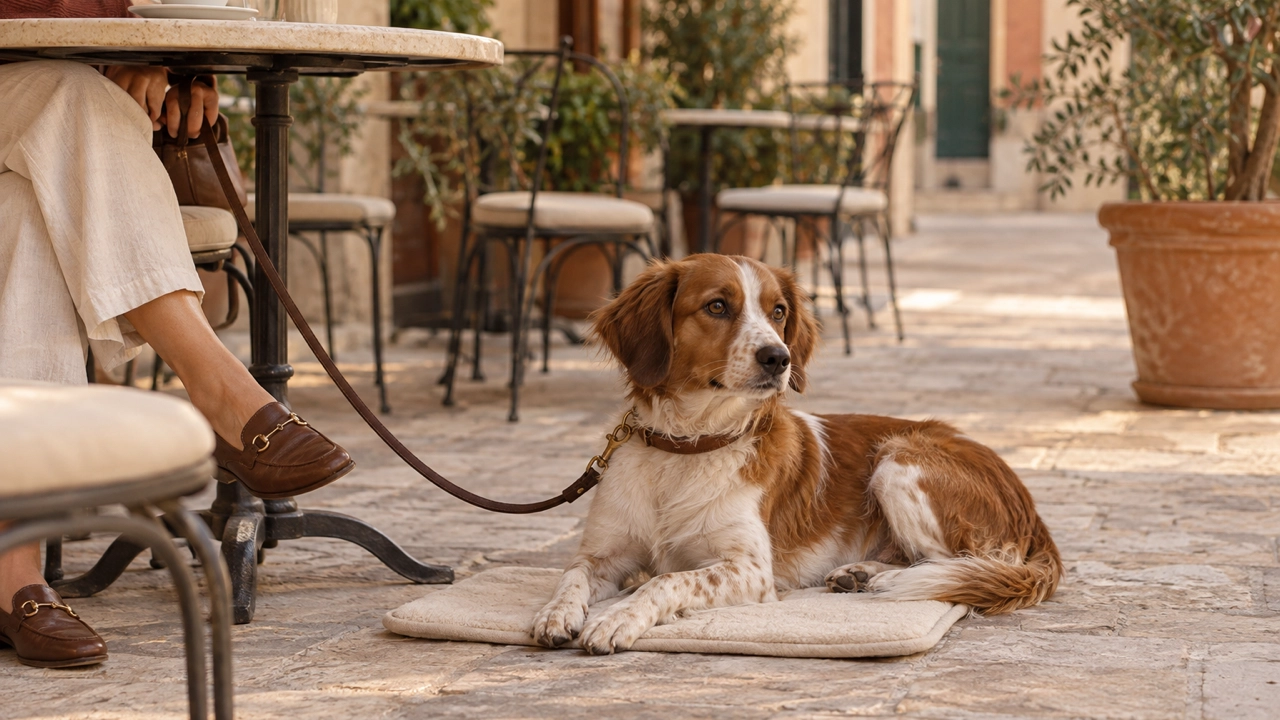
A café is an hour. An office is a shift.
A dog can be content under a table for forty minutes and still find seven hours in an open-plan office impossible. The café is a visit. The office is a recurring part of the week, shared with people who did not choose a dog in the room.
So the question is not whether your office allows dogs. It is whether your dog would choose to spend a working day there, for months.
Day one is not the test
The first visit goes well for almost every dog. New smells, a colleague with a biscuit, a place that is not home.
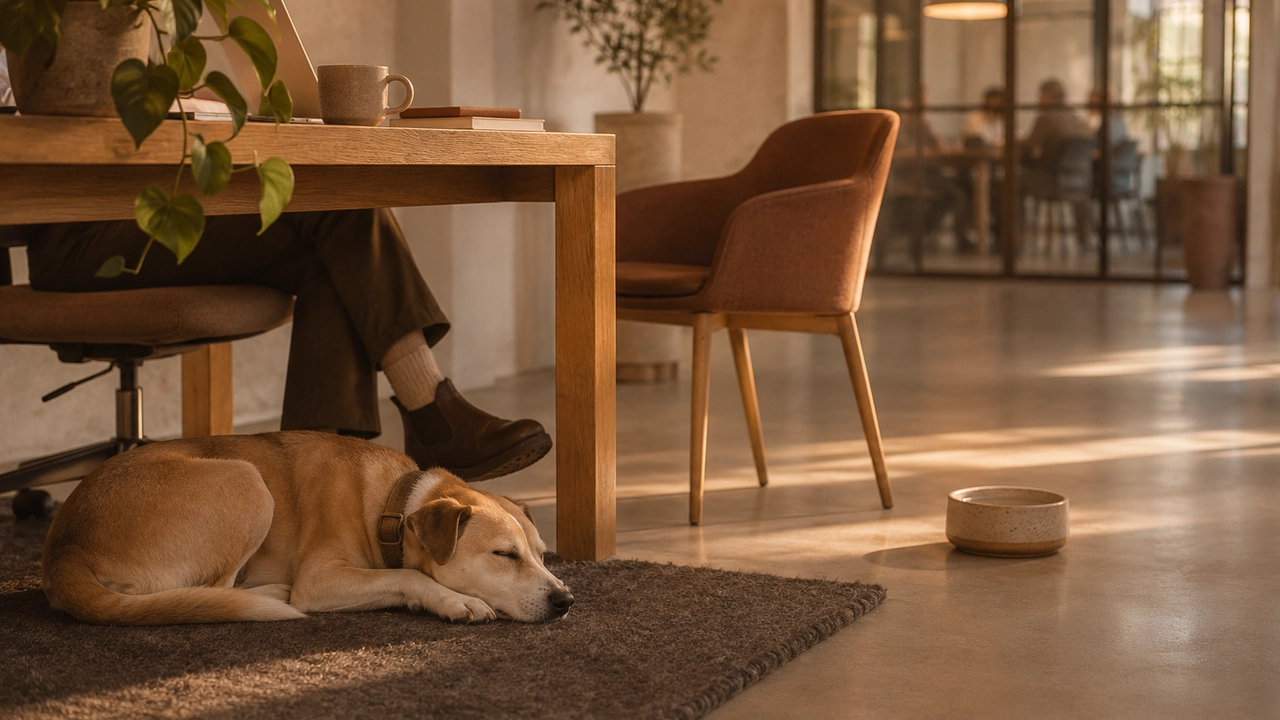
The test arrives later. By the third week the office is ordinary: the lift, the printer, the biscuit. What is left is hours in a building not designed for a dog, and one question. Does your dog sleep there?
A dog who settles, dozes, shifts and dozes again is coping. A dog awake for the whole shift, tracking every chair, is not enjoying an office. They are working in one.
Holding a settle in public is its own skill, and our guide to settling at a café covers it. An office asks for more: not an hour of good behaviour, but a whole day of unremarkable rest.
Three questions worth answering honestly
Can your dog rest there? Not tolerate it. Rest. Under-desk space is shallower than it looks once a bag, a bin and a nest of cables are in it. A dog needs somewhere flat, out of the walkway, away from the chair that rolls back without warning. If the only spot is behind your chair or across a doorway, your dog spends the day being moved.
Is the building suitable? Ask about lifts and stairs: a dog who cannot manage four flights will not enjoy them twice a day. Look at glass doors that appear closed, revolving doors not built for four legs, lobby floors polished to a shine. Count the dogs already there, and ask whether anyone in the team is allergic.
Does everyone want a dog there? The question people skip. Your colleagues agreed to a job, not to a dog under the next desk. Some are allergic. Some are frightened and will not say so to the person holding the lead. Some come from places where dogs are not indoor animals, and some simply do not like them, which is reason enough.
A dog-friendly policy is permission from the company. It is not consent from the room. Ask your employer what it covers, then make it easy for a colleague to say no, and put the desk where nobody has to pass the dog.
Where the dog actually sleeps
Most office-dog problems begin with the bed. It goes wherever there is floor space, which is usually where people walk.
Choose a wall, a view of the room, nothing overhead, room to turn around. A thin mat is not enough over a hard floor and a long day. Take the lead off the chair leg: chairs move, and a dog attached to one learns that resting is risky.
Then find the second place. The opt-out spot: a quiet room, a corner behind a partition, a meeting room nobody books. Somewhere your dog can go when the office is too much, and nobody follows. A dog who can leave a room can stay in it.
No second place, and no way to make one, is information about the fit.
Breaks have to be breaks
Lunch is not a walk. It is a sandwich eaten standing up while the dog waits by a door.
Build the day around two real outings, one before work and one in the middle, plus the toilet trips your dog needs. The gap comes from your dog’s tolerance, not your calendar.
Toilets. Find the outdoor spot before the first day. Grass two blocks away is workable if you know it in advance, and a problem if you find it at eleven. Some dogs will not go on paving; some will not go on a lead at all. Worth knowing before you choose a building with no garden.
Water. A bowl the dog can reach without a colleague stepping over it, refreshed through the day, away from the printer and the kitchen. In a corridor, it gets kicked.
The midday break. Decide who takes it and what happens when a meeting overruns. “I’ll take the dog out at some point” is how a seven-hour day becomes nine.
The commute is the hardest hour
People plan the office and forget the journey. Twice a day, at the busiest hours, your dog manages a lobby, a pavement, a train, and a stranger who wants to touch their head.
Lifts are the pinch point. Small rooms, closing doors, people pressed close, no way out until the doors open. Practise on a quiet evening: up and down, reward calm, step out before your dog worries.
Muzzle rules, carriers and tickets vary by city and network, so check before you plan the route. Our guide to preparing a dog for public transport covers the training. The journey decides whether your dog arrives able to rest.
The signs it is not working
The signs are not subtle, once you know what to look for.
- No sleep. Not a nap at eleven and another at three. None.
- Constant scanning. Head up, ears working, eyes tracking the room.
- Panting without heat, repeated lip licking, yawning in sequence.
- Food refused. A dog who will not take a familiar treat is past their threshold.
- Guarding the space under the desk. A growl at a passing foot is serious in a shared room.
- Toileting indoors, or holding it all day.
- More tired and more wired by Thursday. Cumulative load looks like exhaustion plus restlessness.
The human signs count too. Working less, apologising more, managing a room instead of doing your job.
Fear or guarding at work is worth a conversation with your vet or a qualified behaviourist, not another week of exposure.
The days it should stay home
Some days need no discussion. Fire alarm tests, building work, a full team in one room, a heatwave, a day of calls with nobody free to walk the dog.
Most offices settle into a hybrid. Two or three days a week can be genuinely good for a dog who likes people and rests well. The rest belongs to a walker, a quiet house and a long morning walk, which is not a lesser version of the same thing. Often it is the better day. Our guide to whether dog daycare is worth it sets out the alternatives.
Would your dog choose it?
Dogs do not vote in words. They vote with sleep, with the door, with the third week.
A dog who walks in, settles on their bed and is asleep before you open your laptop has answered. So has a dog who stands by the door at ten, paces the corridor at two, and is still awake at five. Neither answer is a verdict on you. One dog’s good day at the office is another dog’s long, uncomfortable shift.
Try it slowly. Two half-days, a full day, then a week. Ask one colleague who will tell you the truth rather than the polite version. Watch the dog, not the compliments.
If it works, it is a good thing: company, a change of scene, a walk at lunchtime, somewhere warm to come back to. If it does not, a quiet day at home with a walker is not a failure of ambition. It is the same decision, made in the dog’s favour.